
Powder Handling Valves for Industrial Processing
Engineered to Prevent Bridging, Packing, and Material Build-Up
Valves for powders have more performance challenges than gas or liquid valves and therefore require more consideration of available options and customization.
GEMCO Valve Spherical Disc Valves are engineered to eliminate common problems associated with these types of materials through full-port flow, self-cleaning action, and a cavity-free design.
Why Traditional Powder Valves Fail
Bridging, jamming, and material packing are three of the most common causes of valve failure in powder processing.
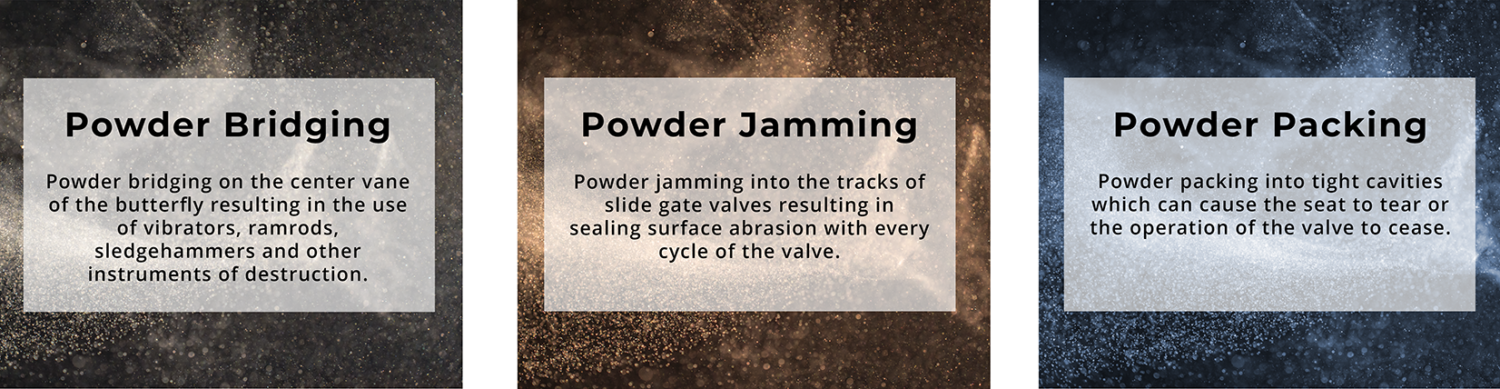
GEMCO Valve's solutions for powders bridging
Full Port Openings
Unlike a butterfly valve the shutoff disc swings completely out of the flow of the powder preventing bridging and promoting mass flow.
GEMCO Valve's solution for powders jamming
Self-Cleaning Areas
Unlike a gate valve, the self-cleaning action tends to wipe the powder away from the sealing area instead of jamming abrasives into the sealing track.
GEMCO Valve's solution for powers packing
No Pinch Points
With a spherical disc or dome valve shape there are no tight cavities for powder to pack and jam-up causing the seat to tear or the operation to cease.
Common Powders Our Valves Can Process
Abrasive Powders
Abrasive High Temperature
Wet Filter Cake/Pharmaceutical
Pharmaceuticals
Methanol
Dimethyl Sulfide (DMS)
Acetone
Active Pharmaceutical Ingredient (API)
Agglomerated Whole Milk Powder
Agricultural Chemical Powder
Alum
Versal Alumina
API Micro Powder Slurry
Bicarbonate Powder
Biomass Feed
Bleaching Earth (Tonsil)
Bulk Powder
Calcium Carbonate
Calcium Oxide (CaO)
Carbon
Carbon Black
Activated Carbon
Coal
Ceramic Particles
Chemical Powder
Specialty Chemicals
Chemical API HCI
Generals Chemical
Chlorine
Cocoa
Confidential Bulk Powder
Dense Phase Convey High Temperature Alumina Powder
Dried Gelatin Powder
Dry Crystals
Dry Food Powders
Dry Free Flowing Powders
Dry Powder Blends for Food Products
Dry Powdered Polymer
Dry Spices
Dust
Explosives
Fibers
Fine Powder
Fine Solids
Flour
Flour-Based Products
Sodium Chloride Salt
Baking Soda
Salt Grains
Food Ingredients
Food Meal
Food Spices
Milled Sugar
Granulated Sugar
Generals Chemical
Volatile Alcohols
Glycerin
Co3O4/Mno2 on Tio2 Micropheres
Graphite
Ground Limestone Powder
Hydrochloric Acid (HCL)
Aluminum Powder
High Nickel Cathode Active Materials
Hot Dirty Glycerin Fatty Salts
Glycerine Pitch
Hot Glue
Metal Powder
KOH (Caustic Potash)
Limestone
Lithium
Lithium Salts
Live Crude Oils
Magnesium Oxide Powder
Magnesium Powder
Maltodextrin
Manganese (Mn)
Mno2 (Pyrolusite)
Media
Media Bromine
Isopropyl Alcohol
Microcrystalline Cellulose
Milk-Based Protein Powders
Ndfeb (Sintered Neodymium Iron Boron)
Nutraceuticals Supplement Powders
Nitrogen N2
Nuclear Waste
Nutraceutical Blends
Pharma Powders
Medicine Powder
Pharmaceutical Wet Cake
Phosphorus Chemicals
Phosphates Phosphoric Acid
Phosphorus Pentasulfide (P2S5)
Phosphorus Pentoxide
Pigments
Resin
Ammonia
Polymer Resin
MTBE (Methyl tert-butyl ether)
Polypropylene Pulverized Powder
Potassium Carbonate Solids
Powder Aluminum & Caustic Powder (Sodium Hydroxide)
Powder and Extrusion Catalysts
Powdered Metal
Primary Metals
Calcium
PVC Ingredient Powders
Salt Slurry N2
Glycerol content (MONG)
Gypsum
Cement Powder
Sand
Silica Sand
Sawdust
Seasonings
Salt
Valve Options & Customization
What material options are there?
The powders to be processed will dictate the product contact material. Cast iron, carbon steels, and aluminum can be used for many industrial applications. Corrosive processes will call for the use of stainless steel, and in some cases material laden with solvents or other corrosives will justify the extra expense of using Hastelloy‚ or other high nickel alloy to prolong valve life.
For stainless steel valves of welded construction, 316L grade is preferred. It is more corrosion resistant than 316 stainless steel, and the lower carbon content prevents carbon precipitating from the welded joints.
What seat materials are available?
Very abrasive material will tend to dictate using metal seats versus the more commonly used reinforced Teflon seats.
The metal seal will give longer life and can be used at higher temperatures than Teflon but the shut-off sealing is limited to dust tight, ANSI class IV or ANSI class V. Reinforced Teflon can be used up to 450 degrees F (230 C), and provide Class VI shut-off.
What is the cleanability?
The sanitary requirements of the process will govern the surface finishes and other sanitary options. We define our finishes as follows:
No surface finish (Ra) specified. Sometimes referred to as “mill finish” or “as cast”. Fabricated valves will only have the internal welds ground smooth and flush. Common in general industrial applications where cross contamination or cleanability are not a concern.
#2 finish – Ra 33 to 65 microinch – 150 to 180 grit. Also referred to as “buffed, blended or uniform appearance finish”. Often specified for the outside of equipment that will be washed down.
#4 polish – Ra 16 to 32 microinch – 180 to 240 grit. All fabrication and handling marks removed. Surface is buffed to a uniform satin finish. The #4 polish is typical for the interior of equipment that needs to be cleaned between batches to prevent cross contamination.
#7 polish – Ra 10 to 15 microinch – 240 to 320 grit. All surface imperfections are repaired. Often referred to as “pit free” and “mirror finish”. Used for high purity applications such as processing potent pharmaceutical actives. Also used for products that tend to adhere to surfaces.
For automatic cleaning, spray balls or jets should be considered. Another option is a valve that can be dismantled by hand for inspection and cleaning. For safety reasons the size of such valves are typically limited to an 8″ port diameter due to the weight of individual components.
How much does the valve weigh?
The weight of a valve is especially important for mobile or rotating equipment. High performance and heavy-duty models can weigh four times as much as its regular-duty counterpart. Dust tight, full vacuum, and 1 bar service, is considered to be regular duty service. 90 PSI (6bar) to 150 PSI (10bar) is high performance. An 8-inch manually operated regular duty valve can weigh 55 lbs (25Kg), versus nearly 200 lbs. (90Kg) for an 8″ high performance model.
What are the mounting arrangements?
The typical ANSI 150 # and DIN drilling is used as an industry standard for heavy duty and high performance models. Quick clamps can also be used for applications up to 30PSI (2bar) and port sizes up to 8″.
Some valves will include blind tapped holes, which may be a problem if the valve is mating with existing blind tapped holes. Another option is to choose oversized flanges, which allows for through holes. For regular duty service valves, ANSI and DIN bolting can be overkill and alternative bolting patterns are available.
How is actuation handled?
As with other quarter turn valves; levers, gear drives or chain operators are available. Pneumatic and hydraulic, operators are available in double acting or fail-safe modes. Pneumatic operation should be the first choice for price, reliability, and speed. When handling solids a higher factor of safety is used to calculate seat torque requirements. The factor is typically 1.5 instead of the 1.25 used for liquid and gas valve calculations.
For solids that “set-up” or harden oversized actuator and specially designed discs that can break through the hardened cake are used. Actuators are typically sized for 80-PSI (5.3 bar) pressure. If the available supply air pressure is dependably higher (100 to 120PSI) or lower (40 to 60 PSI), this will factor in the sizing of the actuator.
For fail-safe operation, spring return actuators are the norm. When a spring return type actuator is used, it is oversized to compensate for the spring as well as the unseating, run, and seating torque required for valve operation. This can lead to weight and space problems as well as extra cost. An alternate fail-safe option is to use a double acting actuator with a pneumatic accumulator sufficiently sized to close the valve. If there is a loss of pneumatic pressure, a pressure switch activates the accumulator and operates the valve.
What kind of flow control is possible?
Fast acting (1 to 5 seconds), quarter turn valves are ideal for flow control of solids. A pneumatic (3 to 15 PSI) or electro-pneumatic (4 to 20 milliampere) positioner can take a signal from a manual adjusted pressure regulator, or from a computer controller. The pneumatic positioner is often used in manually operated filling stations, while the electro-pneumatic positioner is typical for automatic loss-in-weight systems.
Experience Quality, Performance, Safety, and Superior Design
Ready to get started? Fill out the form to inquire today. Our experts are ready to answer your questions and guide you to the best solutions.