
This guide explains how valves support cooling systems, safety, and reliable flow control in data centers. We also examine thermal shutoff valves, which stop fuel or another hazardous flow automatically when temperatures reach a specified limit. Process engineers and facility managers can use this as a practical starting point for choosing cooling, isolation, control, pressure-protection, and thermal shutoff valves.
The four most common types of data centers are enterprise, colocation, hyperscale, and edge facilities, with each demanding valves matched to its fluid, pressure, temperature, pipe size, and controls.
The Critical Role of Valves in Data Center Cooling Systems
Valves isolate equipment, prevent reverse flow, relieve excess pressure, and modulate coolant as the server loads shift. To maintain systems uptime and safety, facility managers should watch for common failures such as stuck control valves or leaking isolation valves and follow recommended maintenance practices to prevent cooling inefficiencies or shutdowns.
Data Center Cooling Technologies
Facilities can combine air, chilled water, and liquid cooling, depending on rack density, climate, water availability, redundancy goals, and existing infrastructure.
Air Cooling
Air cooling moves conditioned air across IT equipment to control temperature and humidity. Computer room air conditioners (CRACs) commonly use direct-expansion refrigeration, while computer room air handlers (CRAHs) use chilled-water coils. Ball, butterfly, globe, control, and balancing valves can manage these circuits.
Chilled Water Systems and Chilled Water Distribution
Essentially, a chilled water system circulates cooled water between the chillers, pumps, and heat exchangers. Common choices include isolation, check, butterfly, globe, three-way, and pressure relief valves. Three-way valves mix or divert streams, balancing valves set the design flow, and pressure-independent control valves (PICVs) stabilize the flow as differential pressure changes.
Liquid Cooling: Direct-to-Chip and RDHx
Direct-to-chip systems carry coolant through cold plates mounted on processors, while rear-door heat exchangers, or RDHx units, capture server exhaust heat right at the rack.
Small tubing, dense manifolds, and nearby electronics all raise the risk of leaks, contamination, and pressure loss. High-integrity valves call for compatible seals, low leakage, and suitable flow coefficients.
Immersion Cooling and Two-Phase Systems
Immersion cooling submerges electronics within nonconductive dielectric fluid. In a two-phase system, the fluid boils at the heat source, then condenses in a heat exchanger. Compatible valve materials and clean assembly can help limit contamination and fouling.
Cooling Towers and Condenser Water
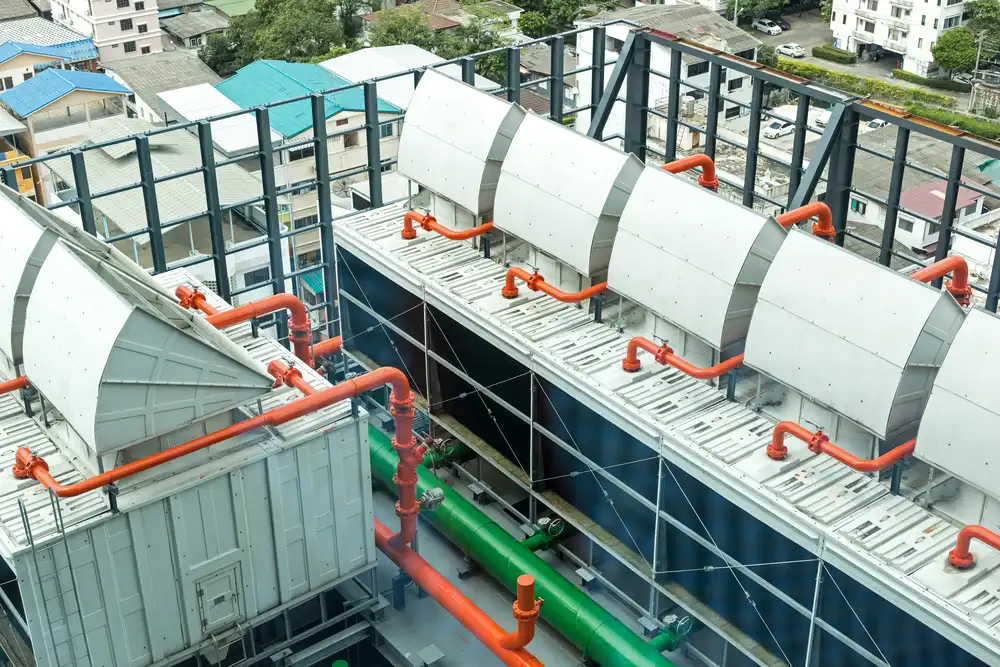
Cooling towers reject heat from condenser-water loops to the outdoor air, commonly using butterfly valves on large lines, check valves at pump discharges, control or bypass valves, isolation valves, and Y-strainers.
Common Types of Valves Used in Data Centers
The primary types of data center valves provide shutoff, throttling, backflow prevention, pressure regulation, or automatic control. Thermal shutoff valves add temperature-triggered protection for fuel or other hazardous-fluid lines.
Ball Valves
- A ball valve rotates a bored ball one-quarter turn for fast shutoff. It’s ideal for low- and high-pressure chilled-water branches, backup-water loops, and diesel-fuel systems where leakage control matters. Simple quarter-turn operation also allows compact actuation.
Butterfly Valves
- A butterfly valve rotates a disc 90 degrees. Its compact, cost-effective design suits large-diameter chilled-water, HVAC, and fire-suppression lines, with manual or motorized versions that prove fast shutoff.
Control Valves
- Control valves modulate flow in response to either the building management system (BMS) or a programmable logic controller (PLC). PICVs maintain intended coil flow as the pressure changes, while electric or pneumatic actuators add remote positioning and status feedback.
Globe Valves, Gate Valves, and Isolation Valves
- A globe valve provides stable, precise throttling in secondary loops and CRAC or CRAH branches. Globe valves also offer finer regulation than gate or ball valves. Gate valves suit isolation, while other isolation valves let crews service equipment without stopping the whole system.
Check Valves and One-Way Protection
- Check or non-return valves support flow in a single direction. These are commonly installed on pump discharge lines or parallel branches to prevent reverse flow, protect pumps, and keep standby equipment from being driven backward.
Pressure Relief and Pressure-Reducing Valves
- Pressure relief valves open automatically to release excess pressure, while pressure-reducing valves maintain a lower downstream pressure.
Solenoid Valves and Fast-Acting Shutdowns
- Solenoid valves use electrical coils for programmable flow control. They connect emergency fuel shutoff, fire detection, and other automated sequences to digital controls.
Fusible Link Valves and Fire-Safe Devices
- A fusible link valve releases a spring-loaded mechanism at its rated temperature to halt hazardous flow in the event of a fire. Strahman’s FLP range starts at 74°C (165°F), with fail-open and fail-closed options for generator and fuel-line protection.
Diaphragm Valves and Immersion Cooling Uses
- A diaphragm valve separates its operating mechanism from the fluid through its flexible membrane. Compatible, low-shedding materials make it useful where dielectric-fluid purity and contamination control are top concerns.
Y-Strainers and Filtration Protection
- A Y-strainer captures debris inside a removable screen. Place it upstream of pumps, control valves, heat exchangers, CDUs, and other sensitive equipment, but leave adequate access for cleaning.
Thermal Shutoff Valves in Data Centers
Thermal shutoff valves respond to excessive heat by moving to a pre-selected safe position, often without waiting for an operator or external control signal. In data centers, they protect diesel generator fuel lines, day tanks, fuel-transfer systems, and other piping that carries combustible fluids.
These valves use a fusible link or a thermal-electric release, and the right design depends on the fluid, operating temperature, required shutoff point, valve size, fail position, fire-safety requirements, and connection to the facility’s alarm or control system. Regular testing confirms that the valve moves freely and reaches its intended safe position.
Choosing Valves for Cooling Fluids and Systems
Choosing the right valves for cooling fluids and systems is vital to ensure reliable operations, safety, and efficiency. Proper selection helps facility managers and engineers feel confident in maintaining system integrity and safety. Match the body, trim, seat, and seal materials to the treated water, glycol blends, refrigerants, dielectric fluids, or fuel. Additionally, check the concentration, temperature, and water chemistry for corrosion risk, and assess velocity and solids for erosion. Where contamination could harm electronics or narrow passages, specify low-dead-leg or hygienic options with suitable filtration.
For thermal shutoff valves, selection should also account for activation temperature, ambient conditions, available reset method, fire-safe certification, and the desired fail position; the valve and release mechanism must fit the specific fuel or process fluid in the line.
Integration, Automation, and Control Strategies
Connect the actuated valves to BMS or PLC logic for remote responses to temperature, pressure, flow, leak, and emergency signals. Choose from electric, pneumatic, or spring-return actuators based on your utilities, response time, and fail position.
Locate the pressure sensors across pumps, strainers, and critical branches, and place flow meters where operators confirm coil, CDU, or rack-loop performance.
Thermal-electric shutoff valves also receive signals from temperature sensors, fire-detection equipment, or emergency control circuits. Fusible-link designs provide a mechanical response after the link reaches its rated temperature.
Maintenance, Reliability, and Safety Considerations
Routine inspections should review packing and body leaks, corrosion, actuator travel, position feedback, strainers, and relief-device condition. You should also exercise seldom-used isolation valves and test emergency shutdowns on a consistent schedule.
Critical loops might need N+1 pumps, parallel branches, double isolation, or bypass paths so that one valve can be serviced without losing cooling. Importantly, verify all fail-safe positions, alarms, and interlocks during commissioning and periodic safety testing.
Thermal shutoff valve inspections should also cover the release mechanism, fusible link, spring assembly, actuator, and manual reset components. Replace heat-sensitive elements per the manufacturer’s maintenance instructions, and document each functional test.
Why Choose Strahman Group for Data Center Valve Solutions?
Since 1921, Strahman Group has built industrial process valves for the most demanding fluid-service applications. The BI-TORQ valve automation line includes actuated ball and butterfly packages, electric and pneumatic actuators, and thermal shutoff valves.
BI-TORQ solutions also include fusible-link and thermal-electric configurations for applications requiring automatic over-temperature response. These can support generator fuel systems and other critical data center safety circuits.
Strahman Group is also ISO 9001:2015 certified and can support custom engineering for application-specific needs. Talk to our valve specialists today about your data center’s cooling, fuel, and safety circuits.