
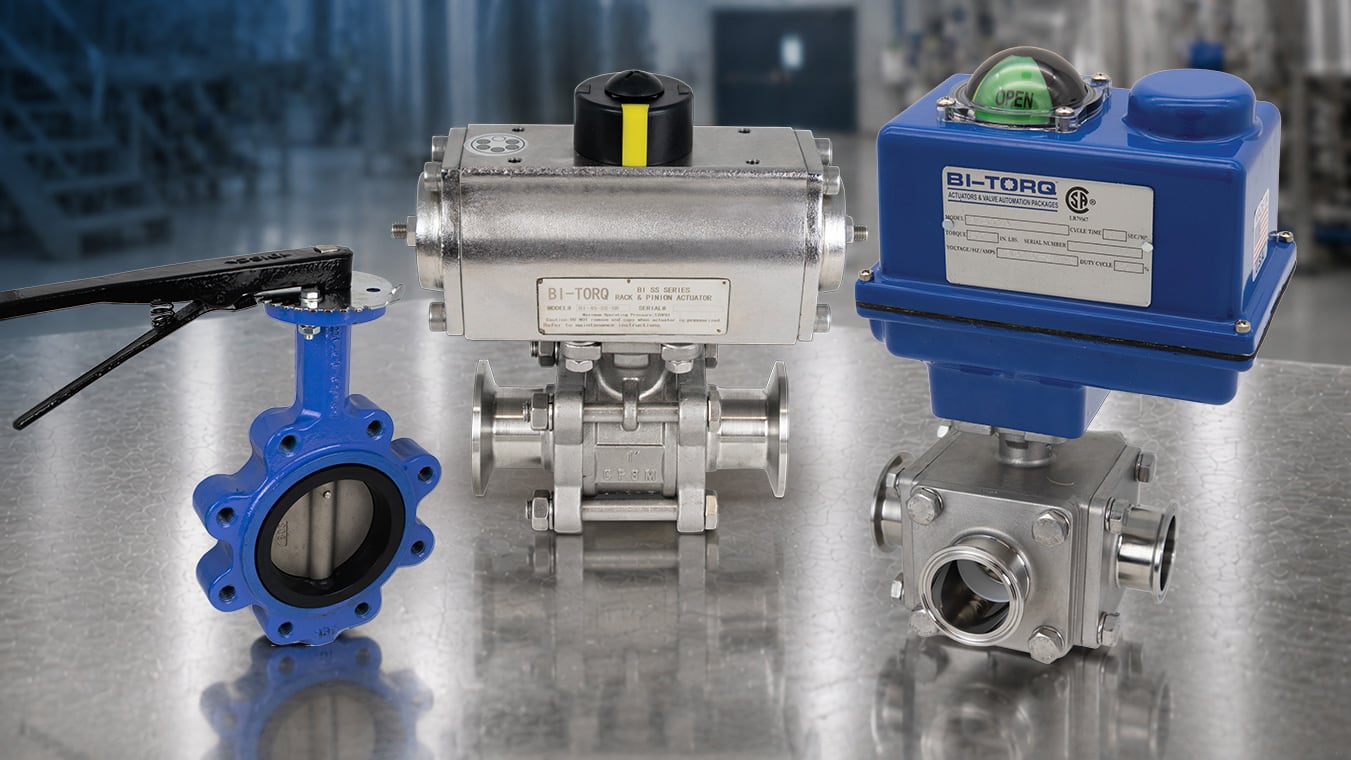
What is the function of a pneumatic actuator? At its core, it converts energy from compressed air into mechanical motion. That motion can be linear or rotary, depending on the actuator design and the equipment being operated.
In industrial valve automation, rotary actuators are commonly used to open, close, or position valves without requiring direct manual operation. Their ability to provide fast, repeatable movement makes them useful across many process applications. Understanding their operation, configurations, controls, and sizing requirements can help determine whether pneumatic actuation is appropriate for a particular valve system.
How Does a Pneumatic Actuator Work?
So, how does a pneumatic actuator work? Compressed air enters a sealed chamber inside the actuator and applies pressure to an internal piston. The resulting force moves the piston, converting pneumatic energy into mechanical movement.
Pneumatic equipment can produce either linear or rotary motion. For quarter-turn valve automation, rack-and-pinion designs convert the piston's linear movement into rotary output. Teeth on the piston rack engage with a pinion, causing it to rotate as the piston moves. The pinion transfers this rotation to the valve stem to change the valve's position.
Compressed air is directed into and exhausted from the actuator as movement is required. This relatively straightforward process helps provide fast, repeatable valve operation.
Double-Acting vs. Spring-Return Pneumatic Actuators
Understanding how a pneumatic actuator works also requires distinguishing between its two common operating configurations.
Double-Acting Pneumatic Actuators
A double-acting pneumatic actuator uses compressed air to power movement in both directions. Air pressure moves the internal pistons to operate the valve in one direction, then is redirected to move the actuator back in the opposite direction. This configuration provides powered opening and closing, making a reliable compressed-air supply an important system requirement.
Spring-Return Pneumatic Actuators
Spring-return actuators use compressed air to move in one direction and stored spring force for the return stroke. If the air supply is lost, the springs move the actuator toward its predetermined position. Depending on the valve, actuator orientation, and process requirements, the assembly may be configured for fail-open or fail-closed operation. The appropriate loss-of-air position should therefore be determined as part of the overall valve and control-system design.
How Pneumatic Actuators Automate Ball and Butterfly Valves
Rotary pneumatic actuators are particularly well suited to quarter-turn valves. Ball valves and butterfly valves typically require approximately 90 degrees of rotation between their open and closed positions.
Connecting an actuator to the valve stem allows that movement to be automated for shutoff, isolation, flow routing, and other process-control functions. Remote actuation can also reduce the need for personnel to physically operate valves, which can be beneficial when valves are difficult to access or located in demanding process environments.
Pneumatic valve automation is used in chemical and petrochemical processing, oil and gas, food production, and other industrial applications. Standardized interfaces also simplify integration. ISO 5211 mounting provides an interface between compatible actuators and valves, while ISO and NAMUR mounting arrangements can accommodate accessories such as switches and positioners.
How Pneumatic Actuators Are Controlled
A pneumatic actuator depends on more than the actuator itself. Controls and accessories determine when it moves, where it stops, and how its position is monitored.
Solenoid valves control the flow of compressed air into and out of the actuator. Limit switches can provide feedback indicating whether the valve has reached its intended position. For applications that require more than simple open-and-close operation, positioners can regulate actuator movement to achieve intermediate valve positions.
These components can also connect valve operation with broader plant control systems. Strahman's valve automation offering, for example, includes solenoids, limit switches, and electro-pneumatic positioners for automated valve assemblies.
Air preparation is equally important. Appropriate filtration and pressure regulation help provide a stable supply of compressed air and reduce the potential for contaminants or inconsistent pressure to interfere with actuator performance.
Pneumatic vs. Electric Valve Actuators
Pneumatic and electric actuators can both automate industrial valves, but they rely on different energy sources. Pneumatic designs require compressed air, while electric actuators use electrical power to generate movement.
Facilities with an existing compressed-air system may find pneumatic actuation practical for applications requiring fast, repeatable movement. Spring-return configurations also provide a mechanical means of moving toward a predetermined position when air pressure is lost.
Electric actuation may be more practical where compressed air is unavailable or where the application's control requirements favor electrical operation. Neither approach is universally better. Available utilities, operating speed, control requirements, environment, and required response during a utility loss should all influence the decision.
How to Select the Right Pneumatic Actuator
Proper actuator selection begins with the valve and actual process conditions. Valve size alone does not determine actuator requirements.
Required torque is a primary consideration. Breakaway and operating torque can vary based on valve design, process pressure, media, temperature, and other operating conditions. The actuator must provide sufficient output at the minimum air pressure expected at the installation.
Other factors include cycle frequency, desired operating speed, and whether double-acting or spring-return operation is required. For spring-return assemblies, the required fail-open or fail-closed position should also be established.
Environmental conditions can affect selection as well. Moisture, corrosion, washdown exposure, and temperature may influence actuator construction and accessory choices. Required solenoids, limit switches, positioners, and other controls should be identified before specifying the complete assembly.
Finally, verify mounting compatibility between the valve and actuator. Oversizing should also be avoided when unnecessary because a larger actuator can increase compressed-air consumption and equipment cost.
Pneumatic Actuator Maintenance and Air Supply
Reliable operation depends on maintaining both the actuator and the pneumatic system supplying it. Routine inspections should check for air leaks in tubing, fittings, and connections, as well as changes in actuator movement or operating speed.
Compressed air should remain clean, dry, and properly regulated. Moisture and particulates can contribute to wear and interfere with consistent operation. Seals and other wear components should be inspected and serviced according to manufacturer recommendations.
Valve travel and positioning should also be checked periodically. Solenoids, switches, positioners, tubing, and connections should remain secure and operate as intended. Changes in speed, air consumption, or valve movement can indicate an air-supply problem or developing mechanical issue that warrants further inspection.
Pneumatic Actuators for Industrial Valve Automation
Pneumatic actuation provides a practical method of converting compressed air into controlled rotary movement for industrial valves. Selecting the appropriate configuration requires considering valve torque, available air pressure, operating environment, controls, and the desired response to loss of air.
Strahman's BI-TORQ line includes pneumatic actuators for industrial valve automation, including double-acting and spring-return configurations. Available options include aluminum and corrosion-resistant stainless steel construction, along with complete automated valve packages and retrofit configurations for compatible existing valves.
Explore Strahman's pneumatic actuator and valve automation options, or contact us for help matching the actuator, valve, torque requirements, and controls to your application.